
Your Policies Are Data Too
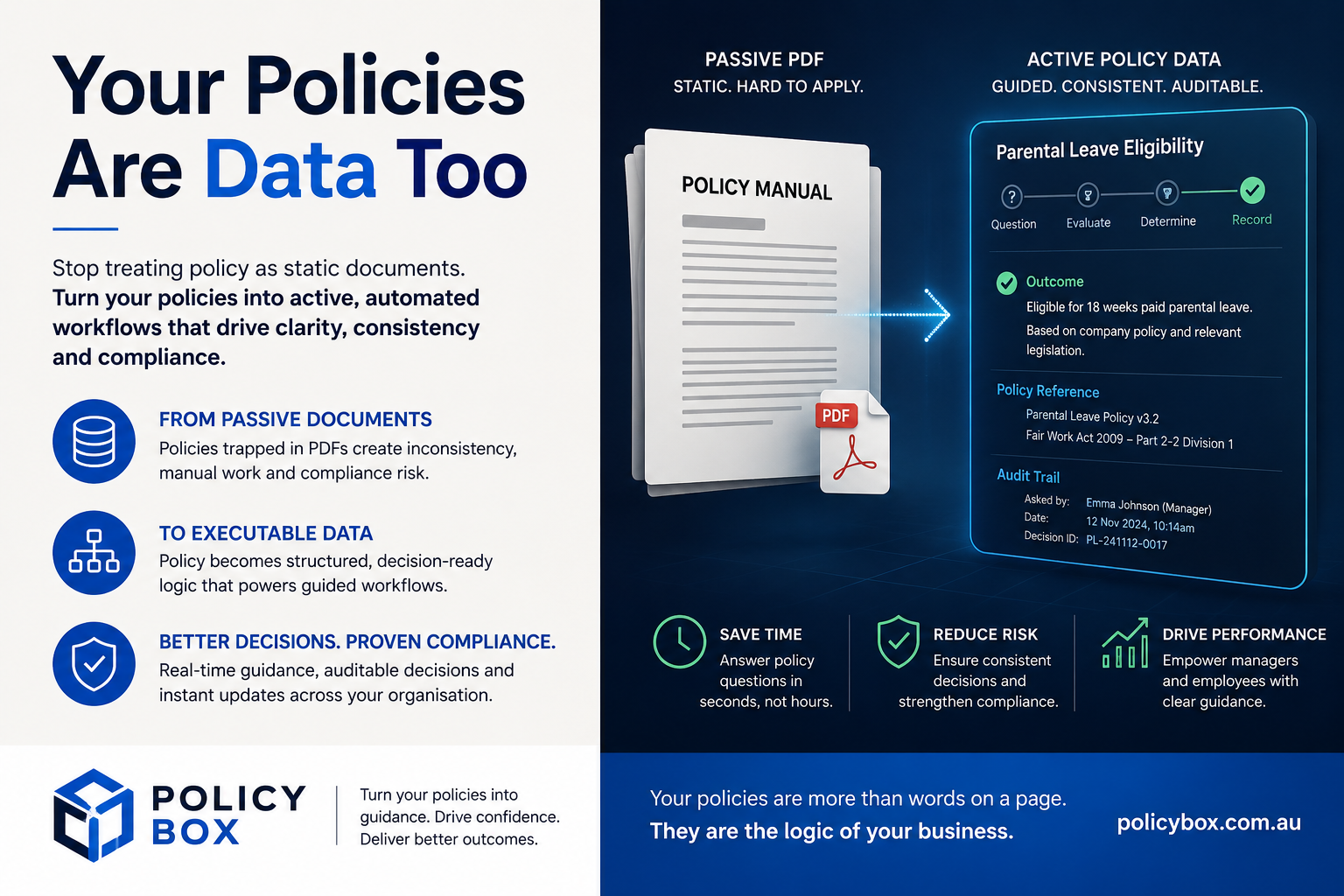
For decades, critical business logic has been trapped in "passive PDFs", static documents that require manual reading and human interpretation to function. While payroll and HRIS systems have evolved into automated engines, your most important policies remained frozen in time. It’s time to stop treating policy as documentation and start treating it as active data.
Database-Driven Use Cases (payroll, HRIS tracking, timecards) became automated, scalable, and instant.
Policy-Driven Use Cases (determining eligibility, managing interpretations, guiding manager decisions) remained stuck in static document repositories.
With modern AI, policy text is no longer passive documentation. It is executable logic. Your policies are data, and the next frontier of HR and operational efficiency is turning written policy into active, automated workflows.
The Shift: Text is Now Executable Logic
When you treat policies as passive documents rather than active data assets, you create predictable operational friction:
Policy Drift: The written policy says one thing, but line managers interpret and apply it three different ways across teams and regions.
Compliance Overhead: HR and ops teams spend hundreds of hours answering the same high frequency, low complexity policy queries ("Can Iclaim this training expense under our L&D benefit?" or "What is our parentalleave eligibility timeframe?").
Audit Blindspots: You know what your policy says on paper, but you have zero real time visibility into how consistently decisions are actually being made against it.
What Happens When You Treat Policy as Data?
When you convert static guide lines into structured, decision ready data assets, three major shifts happen across your organisation:
1. Active Assurance over Passive Manuals: Instead of expecting employeesand managers to wade through 40 page PDFs on the intranet, policy becomes an interactive workflow that guides decisions in real time at the point of action.
2. Auditable Decision Trails: Every policy inquiry or decision generates an auditable record. You can finally measure policy utilisation, spot ambiguous rules before they cause disputes, and demonstrate active compliance to regulators or boards.
3. Instant Policy Adaptation: When labor laws, regulatory standards, or internal frameworks change, updating a central policy dataset instantly updates the operational workflow across the entire business, eliminating thel ag of retraining and broadcast emails.
The Bottom Line for Leaders
The value of an HR policy isn't in its drafting; it's in its operational understanding and how a manager implements it. If your policies only live in a document repository, you don't have active compliance, you have hopeful documentation.
The companies that win on operational efficiency, risk management, and employee experience in the AI era will be those that realise their unstructured policy text is operational data asset.
How is your organisation bridging the gap between written policy and daily decisions? At Policy Box, we turn static compliance and operational guidelines into guided workflows and auditable outcomes. Learn more at policybox.com.au or message me direct for an example of how to turn this into a workflow.
About Lucas Delucyk
With over 25 years of experience driving transformation across retail, FMCG, and government sectors, Lucas empowers executive teams to build highly effective organisations. By leveraging technology, aligning operations, and executing robust strategies, he helps leadership teams navigate complex structural shifts to achieve sustainable growth.